How StatuteFinder and Document the Abuse Help Survivors Build a Case
A collaboration between StatuteFINDER and Document the Abuse
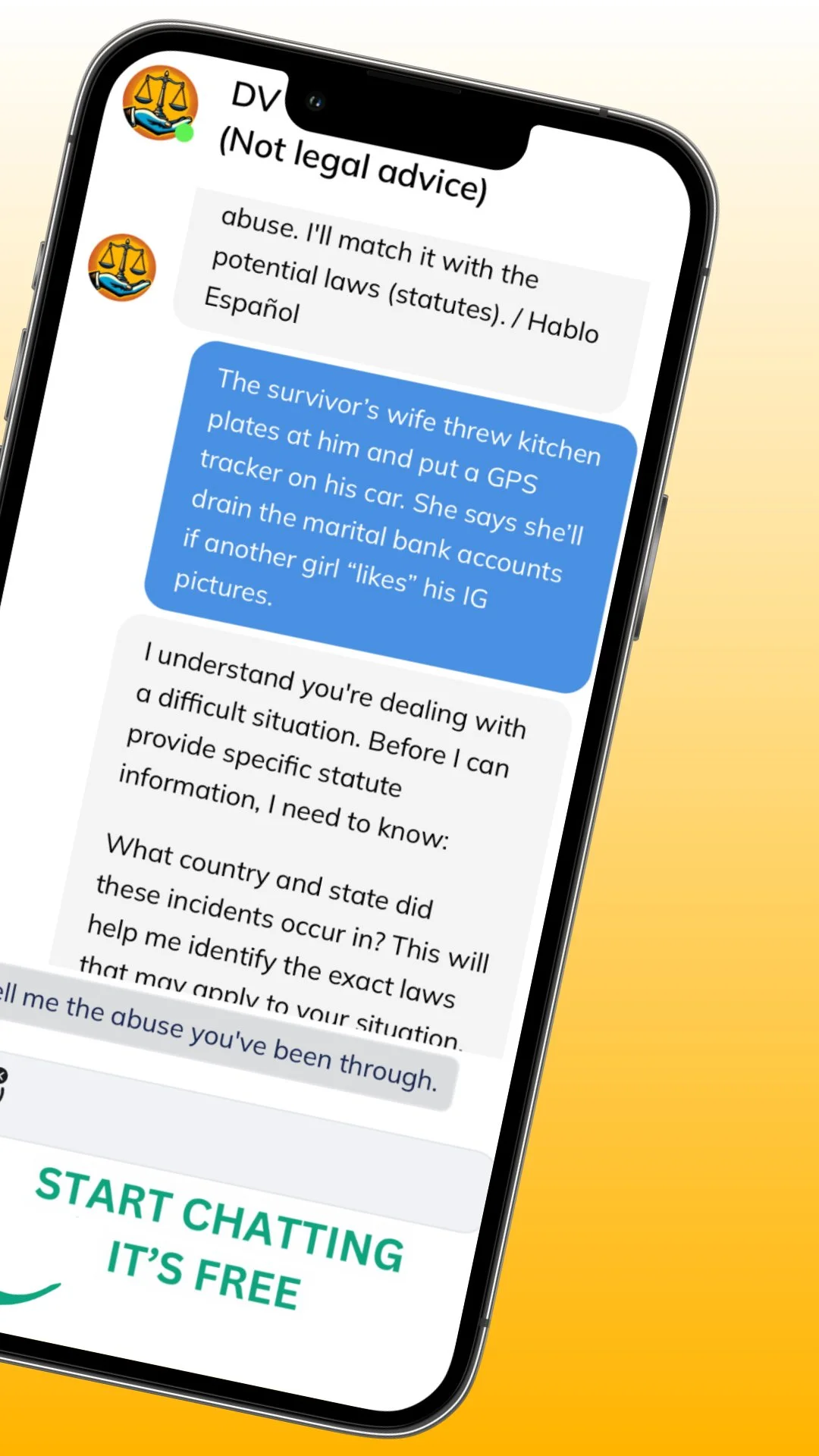
When someone finally decides to reach out for help, they are usually standing at the edge of the scariest moment of their life. They don't know the right words to use. They don't know which office to call first. They don't know that the law already has a name for what happened to them, and that naming it is often the first step toward safety.
This is where StatuteFINDER comes in, and where it becomes even more powerful paired with Document the Abuse's Evidentiary Abuse Affidavit (EAA). Neither tool replaces an advocate, an officer, a nurse, or an attorney. Both work alongside them, clearing the road blocks that keep survivors stuck, confused, or unheard.
Statutes tell a survivor what the law says. The EAA helps them document what actually happened. Put together, that combination, the law plus the evidence, is what turns a fragile case into a strong one.
*This article is for everyday survivors and advocates with no legal background, and no legal background is necessary to find statutes that are relevant to an individual case.
What is a “statute?” A statute is a written law created by a legislature, one that spells out legal rights, requirements, and deadlines survivors need to know. (Cornell Law School's Legal Information Institute)
Let's walk through what this looks like in real life, from the first call for help all the way to the judge's bench.
A Survivor's Path
Picture someone who has been afraid to leave an abusive relationship for a long time. They know something is wrong, but they've been telling themselves that what happens at home isn't "bad enough" to count. That belief, more than almost anything else, is what keeps survivors trapped. Here's how StatuteFINDER, the EAA, and a strong advocacy team can change the outcome at every stage.
1. The First Call
Sometimes survivors don't recognize their own experience as abuse, at least not in the legal sense. National research backs this up: roughly 70 percent of domestic violence is never reported to police at all, often because survivors don't yet have a name for what's happening to them.They know something feels wrong, but they don't have language for it. When a survivor finally works up the courage to call for help, whether that's a hotline, a friend, or 911, they still aren't sure what to say.
This is where statutes become powerful.
When a survivor can see, in plain language, that what happened to them matches the legal definition of stalking, coercive control, or domestic assault in their state, something shifts. They aren't just describing a bad relationship anymore. They're describing a crime with a name and a number attached to it. That clarity gives them the confidence to take the next step and actually leave.
This is also the moment the EAA becomes useful. Once a survivor can name what happened, the EAA gives them a structured way to start recording it right away, dates, incidents, injuries, threats, in their own words, before memories fade or fear takes over. Statutes give the words. The EAA gives the evidentiary record. From that very first call, the two together start building a case that holds up.
2. Filing a Protective Order
Once a survivor decides to seek a protective order, the next hurdle is the paperwork itself. Courthouse forms are not written for people in crisis. They're written for people who already understand the system.
StatuteFINDER helps close that gap in two ways:
It explains where to go. It walks survivors through which courthouse or clerk's office handles their filing, what forms they need, where to get them, and how the process works step by step, so no one is left wandering a government building alone and overwhelmed. It also advises which forms and processes can be filled out and submitted online in lieu of a personal appearance.
It helps build a bulletproof petition. Instead of writing a vague account of "they scare me," a survivor can list the specific statutes that apply to their situation alongside the evidence they've been collecting.
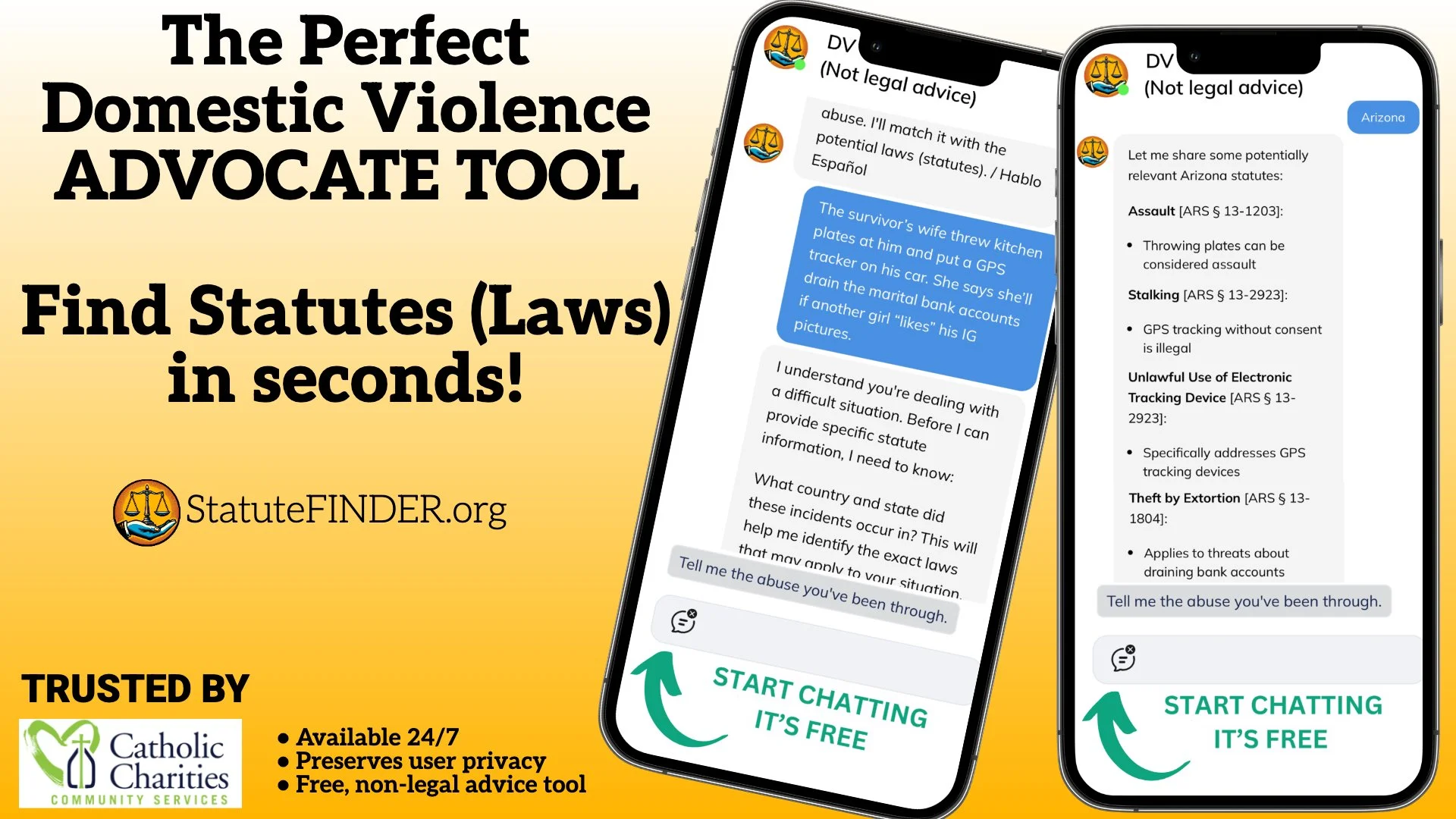
For example, a survivor would write the circumstances of their abuse at StatuteFINDER and immediately receive a statute number for it. “The abuser tried to strangle me in front of my children resulting in a hospital visit in Illinois.” The result is a statute number for Aggravated Domestic Battery (Strangulation) 720 ILCS 5/12-3.3 as well as Child Endangerment 720 ILCS 5/12C-5

This is the point where the EAA does its heaviest lifting. A petition for an order of protection that cites the law and backs it up with a documented, organized affidavit is simply harder to dismiss than one built on emotion alone. It gives the judge something concrete to act on from the very first hearing.
3. Serving the Abuser
An order of protection only works if it gets served and enforced. This is often where survivors run into a wall of indifference. Officers are busy. Domestic cases can feel routine to the people handling them, even though for the survivor, it's the most dangerous moment of their life.
This is where urgency has to be built into the request. When an advocate or survivor can say, clearly and specifically, "This is a direct order signed by a judge, are you prepared to let it go unenforced?" the tone in the room changes. Statutes give that request weight. It stops being a personal plea and becomes a legal obligation the officer is being asked to honor.
4. When the Order Is Violated and Nothing Happens
This is one of the most painful gaps survivors face. They finally have a piece of paper that's supposed to protect them, and then it's violated, and no one seems to respond.
Survivors need a way to hold that line. A phrase we encourage people to have ready is something like: "You took an oath to uphold the law. Here are the specific rights (statutes) that were violated in my case. I'm asking you not to let this go unanswered." When that statement is backed by the exact statute that was broken, it's no longer just a complaint. It's a documented violation that has to be logged and addressed.
Research on protective orders shows that reported violation rates vary widely by study, ranging anywhere from about 7 percent to over 80 percent depending on the population and how violations are tracked, which is exactly why a clear, statute-backed record of each incident matters so much.
This is also where an updated EAA entry matters most. Every violation a survivor logs, with the date, the details, and how it was reported, adds another layer to a growing evidence trail. That paper trail matters enormously if the case moves forward later, and it's much harder for a violation to be minimized or forgotten when it's already written down in a clear, timestamped record.
5. The Hospital Visit
If a survivor is injured, the hospital becomes another critical point in the case. Medical records aren't just about treatment. They become some of the strongest evidence a survivor will ever have. The U.S. Department of Justice has noted that a well-documented medical record can serve as third-party, factual evidence that corroborates or establishes that abuse occurred, which makes it valuable even outside a formal courtroom.
A nurse's notes, photographs of injuries, and a documented timeline can corroborate everything else in the case file. Survivors often don't realize in the moment how important it is to make sure the visit is fully documented, not just treated. Once safe, that hospital visit becomes another entry in the EAA, tying medical evidence directly to the statute it supports.
6. Advocates
Every step along this path is easier with an advocate at the survivor's side. Advocates translate confusing systems into plain language, sit with survivors through terrifying appointments, and help keep the larger picture in view when a survivor is too overwhelmed to see it themselves.
Between StatuteFINDER and the EAA, advocates have two tools that work together well: one that identifies the law, and one that organizes the proof. That combination helps advocates turn a frightening, disjointed story into a clear, statute-backed case file much faster than either tool could on its own.
7. Standing Before the Judge
By the time a case reaches a judge, the survivor is no longer showing up empty-handed. There is a file that lists the specific statutes that apply, an EAA full of dated, organized evidence that supports each one, and a clear account of what happened at every stage, from the first call to the hospital visit to the violated order.
Judges see thousands of cases. The ones that are well organized and grounded in both law and evidence simply move differently through the system. When a survivor can confidently reference the relevant statutes and back them up with a complete affidavit, and ask for protections like exclusive use of the home, judges take notice. It signals that this isn't a case built on panic. It's a case built on preparation.
The Road Doesn't Have to Be This Confusing
This kind of story isn't unusual. What's unusual is what happens when a survivor has the right information and the right documentation at each step, instead of having to guess, stumble, and often give up. That's the gap StatuteFINDER and the EAA aim to close together. Statutes without evidence can be dismissed as opinion. Evidence without statutes can feel disorganized and hard to act on. But statutes paired with evidence, from the very first call, is what leads to a better outcome.
No survivor should have to become a legal expert overnight just to be safe. But when the law is made clear and the evidence is kept organized at every stage, from that very first call for help to the moment they stand in front of a judge, survivors stop feeling powerless in a system that was never built with them in mind. They start feeling like they have a case. Because they do.
StatuteFINDER.org and Document the Abuse are partner organizations working to make the legal system more navigable for survivors of domestic abuse.
Other articles of interest from our Learning Hub:
To Every Advocate that Feels They are Not Enough
Why Didn’t She Report Her Abuse?
The EAA Can Help Even If You Never Go to Court
Behind every download of the Evidentiary Abuse Affidavit, every resource accessed, and every article read is a survivor looking for a way forward. Your donation, whether a one-time gift or a recurring monthly contribution, makes sure those resources stay free and within reach. No survivor should have to go without the tools that could protect their life.

If you are a victim of violence, stalking, or harassment this link takes you directly to the Evidentiary Abuse Affidavit. CLICK HERE
If you need help immediately please dial 9-1-1