It's Time for Action, Not Just Awareness
Beyond October

Domestic Violence Awareness Month - October, 2026
Every 3 seconds, a person is assaulted by an intimate partner in the United States. That's not a statistic to scroll past. That's 10 million people a year. Real people. People you know.
October comes, and we drape everything in purple and teal. We post awareness ribbons. We share statistics that shock us for a moment before we move on to the next thing. And then November arrives, and the conversation dies. But abuse doesn't stop. The system that failed to protect someone in October fails them again in November, December, and every month after.
We need to say this clearly: awareness without action is empty.
The System Is Broken.
Let's Stop Pretending Otherwise.
A woman files for a restraining order on Monday. It takes until Friday, or sometimes weeks, to get a hearing date. The abuser isn't served until they can be found. By then, there’s been time to escalate. To plan. To find her.
She gets the order. He violates it. The police response is lukewarm. The prosecutor's office is overwhelmed. No charges are filed. He tries again. Still nothing. What does he learn? That the system is on his side.
This is not rare. This is standard.
In the United States, nearly 4 in 10 women and more than 1 in 10 men experience severe intimate partner violence in their lifetime. That's millions of people. Yet most domestic violence cases that reach prosecution don't end in conviction. Many never reach prosecution at all. Charges get dropped. Evidence goes missing. Cases are archived. The victim moves on, thinking maybe the system just didn't believe her.
She's wrong. The system didn't fail to believe her. It made a choice. A choice to prioritize other cases, to not follow up, to let delays stack up until the victim gives up.
The Escalation Is Predictable.
The Outcome Doesn't Have to Be.
This is the part that keeps us awake: the abuser's violence follows a pattern. It gets worse. It always gets worse.
It starts with control. Then it escalates to physical violence. Then it gets more brutal. Then the threats come. The strangulation. The access to weapons. And if nobody intervenes, if nobody holds the line, if the system keeps offering delays and second chances instead of accountability, then we're mourning a death or looking for a missing person.
We can predict who is at lethal risk. When someone has strangled their partner, when they have weapons, when they're stalking, when they're isolating her from everyone she knows, when they're becoming more jealous and controlling, these are not secrets. These are signals. Loud ones.
And when a victim tries to leave? The danger spikes. By 75 percent. For years. That window when she's planning escape or has just left is the most dangerous time of her life. And what does the system do? It moves slowly. It doesn't show up. It dismisses her fears.
Every delay in serving a restraining order is another day he's still free. Every violated order that gets ignored is permission for the next assault to be worse. Every case archived without investigation is a message: we're done trying.
SOLUTIONS
For Organizations and Shelters:
Build the Coordinated Response
Stop working in silos. Your police department, court system, shelter, and victim advocates need to move as one team. Not in the same building. Not even coordinated after the fact. Moving together in real time.
When a victim files for an order, the advocate should know.
When a violation is reported, the prosecutor should be notified immediately.
When bail is set, the advocate should be in the room.
This coordinated response model works. Communities that implemented it saw repeat violence drop and victim safety improve dramatically.
Make restraining orders fast. A victim should walk out of court with an emergency order the same day she files. Then that order needs to be in the abuser's hands within 48 hours. Not a week. Not ten days. This is doable. We have the technology. We just need the will and the funding.
Hire advocates who know the system. Someone should be with every victim walking through court, explaining her options, documenting everything, preparing her for the next step. Tools like the Evidentiary Abuse Affidavit (EAA) can help survivors document patterns of abuse in a structured, legally sound way giving prosecutors the kind of evidence they can actually use. Advocates who know how to help victims complete an EAA, how to gather supporting documentation, and how to build an evidence file make all the difference. This is the difference between a piece of paper and an actual protection plan. It's also the difference between victims who follow through and victims who give up because it's too overwhelming.
Track violations like your life depends on it. Because someone's does. Create a system where every violation is logged, every report triggers immediate action, and every violation carries real consequences. Jail time. Not a warning. Not probation. Jail. Abusers have to learn that the order is not just a piece of paper.
Share information across agencies. Police need to know about active restraining orders. Courts need to see prior violence history. Advocates need access to police reports. Set up a shared database. Stop making victims repeat their story to three different systems.
For Law Enforcement:
Stop Waiting and Start Protecting
Assess risk at every call. When you show up to a domestic violence call, ask the hard questions. Has he strangled you? Does he have guns? Has he threatened to kill you? Is he more jealous and controlling than he used to be? These aren't therapeutic questions. They're triage. They tell you who's about to die.
Enforce violations without hesitation. A violated restraining order is not a gray area. It's not a "let him off with a warning" moment.
It's an arrest.
It's charges filed.
It's prosecution.
And it's a sentence with teeth. This is how abusers learn that the order means something.
Remove firearms. Every. Single. Time. If he has a protective order against him, federal law (The Lautenberg Amendment) says he shouldn't have guns. But enforcement is practically nonexistent in most places. Create a unit dedicated to this. Verify compliance. Conduct home visits. Because 54 percent of domestic violence homicides involve guns that should have been removed. Those deaths are preventable.
Build a domestic violence unit. One detective can't handle these cases. They're complex. They require trauma-informed training, understanding of coercive control, and the time to build evidence when victims are afraid to testify. Hire specialized officers. Train them. Support them so they don't burn out.
Talk to advocates. When you follow up on a case, talk to the victim's advocate about what they've documented. If a victim has completed an Evidentiary Abuse Affidavit, that document can provide the kind of detailed pattern evidence that transforms a weak case into a prosecutable one. Shared information and shared tools let advocates adjust safety planning and prosecutors build stronger cases. You're not the only people protecting her. Work together and use every tool available.
For Legislatures:
Pass Laws That Enforce, Not Just Acknowledge
Mandate 48-hour timelines. Write it into statute. Restraining orders filed today are served within 48 hours. Not ten days. Not "within a reasonable timeframe." Forty-eight hours. And violations carry jail time, not probation or anger management classes. The research is clear: abusers don't respond to soft consequences.
Require public data on restraining orders. Every jurisdiction must report: how many filed, how many granted, how many served, how long it took, how many violations, how many prosecuted. Publish it. When performance is measured and public, it improves.
Criminalize violation patterns. One violation might get dismissed. But a pattern of violations is coercion. It's abuse. Make it a felony when there's a history and ongoing fear.
Train every judge on lethal risk. Judges need to understand that strangulation is a death warning. That access to weapons changes everything. That isolation and control are precursors to homicide. Train them. Then hold them accountable if they're still handing custody to known abusers or setting bail too low.
Fund specialized prosecution teams. Domestic violence cases are hard to prosecute. Victims recant. Witnesses disappear. Two generalist prosecutors in the entire district won't cut it. Hire specialists who understand trauma, who can build cases despite victim hesitation, and who have the tools and time to work with comprehensive abuse documentation like the Evidentiary Abuse Affidavit to strengthen their cases.
Protect custody decisions. Stop awarding joint custody to known abusers. Stop giving them continuing access to the victim and kids. When abuse is documented, let that inform custody decisions. Don't hand the abuser a legal mechanism to keep controlling his victim.
Fund shelters to full capacity. Too many shelters have waiting lists, some communities are without any shelter resources. A woman calls seeking safety and gets turned away. That's not acceptable. Fund every bed. Emergency protection is basic infrastructure and a basic human right.
For Everyone Else:
This Requires Your Voice
Know the signs of lethal risk. If someone you know has a partner who strangles them, who has threatened to kill them, who has guns, who's isolating them from everyone, who's becoming more jealous and controlling, please tell them. Name it. Don't minimize it. This person is in extreme danger.
Understand that leaving is the danger zone. When someone leaves an abusive partner, the risk of lethal violence skyrockets for at least two years. If you know someone planning to leave, help them make a safety plan first. Connect them with an advocate. Don't just tell them to go.
Document everything. If you witness abuse or if someone you know is being abused, help them document it. Write down dates, times, injuries, witnesses. Take photos of marks. Get medical records. Tools like the Evidentiary Abuse Affidavit (EAA) are designed to help survivors organize this documentation in a structured, legally credible way. An advocate can help someone complete an EAA, giving prosecutors the detailed evidence they need to build a case that sticks. This documentation can make the difference between a conviction and a dropped case. As a bystander witness you can create your own EAA to keep your observations preserved while they are still fresh.
Support advocates directly. An advocate who walks a victim through filing for a restraining order, through court preparation, through safety planning, that person is worth more than a thousand awareness campaigns. Donate. Volunteer. Make it possible for advocates to do this work.
Vote for enforcement. When your city or state votes on funding for prosecution teams, victim advocacy, shelter capacity, or restraining order timelines, show up. Vote for the candidates who actually fund this work. Not just the ones who talk about it.
Demand transparency. Ask your police department:
How many domestic violence calls?
How many resulted in charges?
How many prosecutions ended in conviction?
How long to serve restraining orders?
How many violations reported?
How many prosecuted?
If they won't tell you, you have your answer. The system hides when it's failing.
Make noise when the system fails. When an abuser violates a restraining order and walks free, contact the prosecutor. Contact the judge. Ask why. Make noise. The system moves when it's watched.
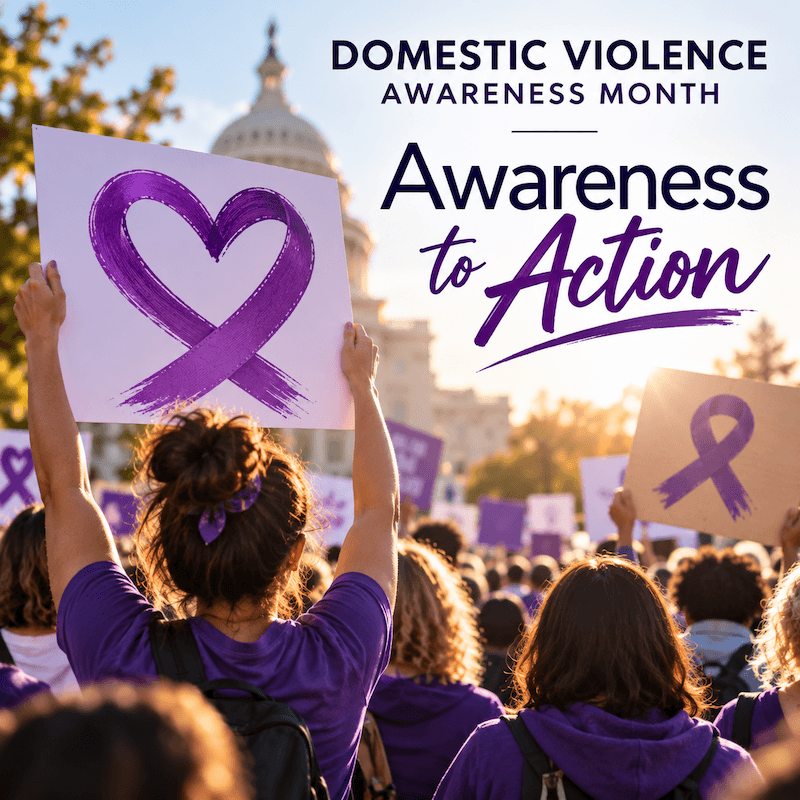
This Is What Action Looks Like!
October is coming again next year. The ribbons will come out. The posts will be shared. People will feel moved for a moment.
But this year, we need to do something different! We need to translate that moment of concern into a demand for change. We need to hold systems accountable. We need to make restraining orders matter. We need to make violations cost something. We need to make prosecutors show up. We need to make judges understand that strangulation is a death warning.
We need to stop performing compassion and start demanding justice.
This is not complicated. Organizations can coordinate. Police can enforce. Legislatures can legislate. Everyone else can show up.
A victim doesn't need more awareness that she's being abused. She knows. She lives it every day. What she needs is a system that moves fast, enforces orders, and treats her safety as the emergency it is.
Demand action. Demand enforcement. Demand timelines. Demand accountability.
Demand that October means something.
Victims remember. The dead cannot speak. It's time the system did more than listen. It's time the system acted.
For more information refer to these articles from our Learning Hub:
How Document the Abuse and StatuteFINDER Help Survivors Build a Case
When “He Said, She Said” Hurts Everyone
Why Didn’t She Report Her Abuse?
The EAA Can Help Even If You Never Go to Court
Behind every download of the Evidentiary Abuse Affidavit, every resource accessed, and every article read is a survivor looking for a way forward. Your donation, whether a one-time gift or a recurring monthly contribution, makes sure those resources stay free and within reach. No survivor should have to go without the tools that could protect their life.

If you are a victim of violence, stalking, or harassment this link takes you directly to the Evidentiary Abuse Affidavit. CLICK HERE
If you need help immediately please dial 9-1-1