The Intersection of Domestic Violence & Missing Persons
Every missing person case begins with the same desperate question: Where are they?
But in far too many cases, there's another question hiding just beneath the surface, one that gets asked too late, if it gets asked at all: What was happening behind closed doors before they disappeared?

The connection between domestic violence and missing persons isn't coincidental. It's deeply, undeniably linked. And understanding that link could mean the difference between a tragedy and a prevention, between a delayed response and an immediate one, between a victim being dismissed and a victim being believed.
The Story Usually Starts Long Before the Disappearance
Domestic violence rarely announces itself with a single dramatic moment. It creeps in quietly through coercive control, through isolation from friends and family, through financial manipulation and escalating threats. By the time physical violence begins, a pattern of power and fear has often been in place for months or even years.
This is exactly why, when a person disappears, especially a woman in an intimate partner relationship, those earlier warning signs matter enormously.
Research consistently shows that the moment of separation, or even the attempt to separate, is one of the most dangerous periods for a victim. The risk of serious harm or homicide spikes precisely when someone tries to leave. In some cases, a disappearance isn't random at all, it is the final, brutal escalation of ongoing abuse.
Families often say afterward, "We knew something wasn't right." The heartbreak is that those signs were there long before anyone filed a missing persons report. And in too many of those cases, the victim had never been given a structured way to record what they were living through before it was too late.
Why the Domestic Violence Connection Gets Overlooked
When a missing persons investigation begins, the focus naturally falls on immediate details; last known location, phone records, vehicle descriptions. Those details are critical. But when investigators and communities overlook the domestic violence context, vital pieces of the puzzle get delayed or lost entirely.
This happens for predictable reasons. Abuse is often never formally reported. Victims minimize the violence to protect themselves or their children. Friends and family may not recognize coercive control as abuse because it doesn't leave visible bruises. And abusers are frequently skilled at presenting a calm, credible, even charming public face.
This is precisely where a tool like the Evidentiary Abuse Affidavit (EAA) becomes critically important. The EAA was specifically designed to give victims a legally structured way to document their abuse in their own words before a crisis occurs. It captures the kind of detailed, pattern-based evidence that informal notes or memory alone cannot reliably preserve, and it does so in a format that law enforcement and courts can actually use.
Domestic violence leaves patterns, not just injuries. When someone disappears, those patterns, the fear, the control, the gradual isolation must be examined carefully and immediately. The EAA exists to make sure those patterns are on record.
The Risk Factors That Demand Attention
Certain dynamics significantly increase the danger level in abusive relationships. Prior threats to kill, a history of strangulation, escalating jealousy or surveillance, access to weapons, stalking behavior, a recent separation or divorce, contested custody disputes, and sudden financial changes are not simply "relationship problems." They are predictive indicators of potential lethality.
The EAA directly addresses these risk factors. It prompts victims to document specific incidents, threats, and patterns of behavior in precise detail creating a record that reflects the true danger level of their situation and details of its escalation.
When these factors are present and someone goes missing, a completed EAA can immediately signal to investigators that this is not a voluntary disappearance. It can shift the entire trajectory of a case from the very first hours.
The Dangerous Myth of "She Just Left"
One of the most harmful narratives in missing persons cases involving domestic violence is the assumption that the person simply walked away. That they needed space. That they were unstable or irresponsible. That their absence is voluntary.
Abusers frequently exploit this narrative. They may insert themselves into search efforts, cast doubt on the victim's mental state, or suggest the disappearance fits a pattern of erratic behavior.
This is one of the most powerful reasons the EAA matters so deeply. Because it is completed by the victim, notarized, and securely stored before anything happens, it exists as an independent, documented voice that cannot be silenced, manipulated, or rewritten. If an abuser later tries to control the narrative claiming she was unstable, that she simply left, that her fears were exaggerated the EAA stands as a direct counter to that story, in her own words, recorded while she was alive and able to tell it.
A disappearance that makes no sense in context often makes complete sense when the history of abuse is examined. The EAA helps ensure that history doesn't disappear along with the person.
Documentation: The Tool That Can Change Everything
One of the most powerful steps a domestic violence victim can take, and one of the most important things advocates and legal professionals can encourage, is documentation. Not because documentation stops violence on its own, but because it creates a record that can protect someone's life and, if the worst happens, help investigators act faster.
The Evidentiary Abuse Affidavit (EAA) was created for exactly this purpose. Developed with legal and law enforcement input, the EAA is a structured, notarized affidavit that a victim completes in their own words, describing the abuse they've experienced in documented detail. Once completed, it is stored on the secure site and the victim may choose to share it with a trusted third party, an attorney, a family member, an advocate, or an organization like the CUE Center for Missing Persons, with instructions that it be released to law enforcement if the victim goes missing or is harmed.
The CUE Center for Missing Persons recognizes the EAA as a vital component of missing persons preparedness in domestic violence situations. When families and victims work with organizations like CUE and utilize tools like the EAA together, they build a comprehensive safety net, one that can speak on a victim's behalf even when she no longer can.
Documentation through the EAA isn't about anticipating the worst. It's about refusing to be silenced by it.
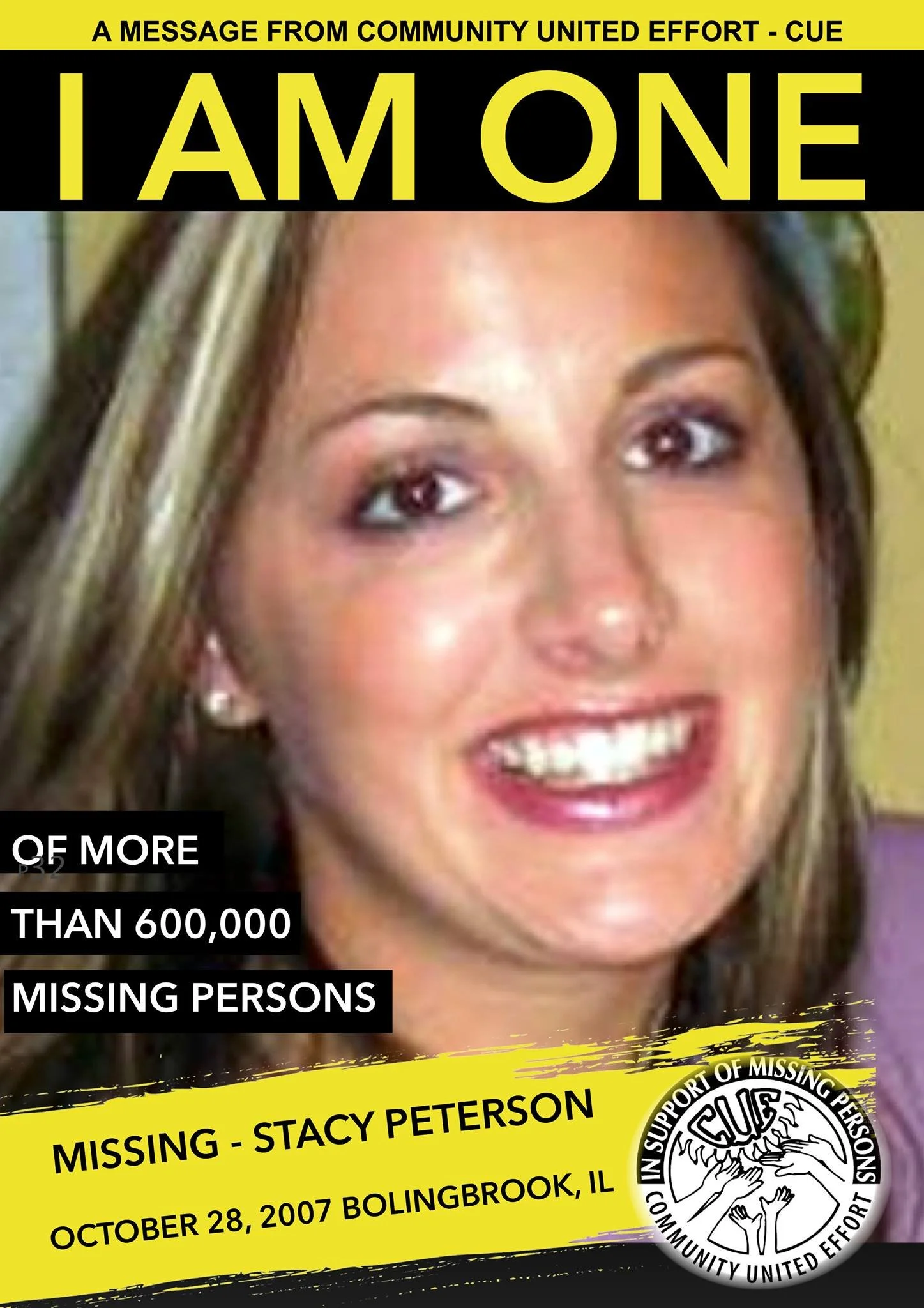
I AM ONE
CUE Center for Missing Persons conducts several awareness outreaches. I AM ONE is a Facebook Community that serves as a public reminder of families left behind who suffer the loss of a loved one. The awareness campaign was launched in 2015 to highlight missing persons and unsolved homicides.
When Systems Work Together, Lives Are Saved
The most effective responses happen when domestic violence advocates, law enforcement, legal professionals, and missing persons organizations like the CUE Center operate as a coordinated team rather than in separate silos.
A unified approach allows for immediate risk assessment and victimology when a domestic violence victim goes missing, a thorough review of prior police reports and protection orders, efficient cross-reporting between agencies, faster search mobilization, and trauma-informed communication with devastated families. When a completed EAA is part of that file, securely stored and ready to be released, it gives every member of that coordinated team the documented context they need to act decisively and quickly.
Communities matter too. Friends, coworkers, neighbors, people who noticed something was wrong long before the disappearance have a role to play. If something feels off, it is worth saying out loud. The people closest to a victim are often the first to sense danger and the last to be asked.
Prevention Is Possible But Only If We're Paying Attention
The intersection of domestic violence and missing persons isn't only a story about response. It's a story about what happens when warning signs are caught early, when survivors are believed the first time, when documentation is encouraged before the crisis, and when the systems meant to protect people actually work together.
The Evidentiary Abuse Affidavit is one of the clearest examples of prevention in action. It asks victims to do something incredibly difficult, to look clearly at what is happening to them and put it into words, and it honors that courage by ensuring those words are preserved, protected, and ready to be heard.
Disappearance is often the last chapter of a much longer story. The EAA is a way of writing that story down before someone else can erase it.
Questions we are frequently asked:
-
Research shows that domestic violence, particularly intimate partner violence, is a significant factor in many missing persons cases. The period surrounding separation or attempted separation is statistically one of the most dangerous times for a victim, and some disappearances represent the final escalation of long-term abuse rather than a voluntary absence.
-
Documentation, especially through a simple tool like the EAA, creates a record that cannot be manipulated or denied later. Abusers frequently attempt to control the narrative after a disappearance, claiming the victim was unstable or left voluntarily. A pre-existing, notarized affidavit counters that narrative with the victim's own documented account, created while they were able to tell their story.
-
The EAA can be stored securely on the web based app, or the victim may choose to share it with a trusted attorney, a family member, a domestic violence advocate, or an organization such as the CUE Center for Missing Persons. The key is that it is held by someone outside the home, with clear instructions to release it to law enforcement if needed.
-
The CUE Center for Missing Persons provides investigative support, family advocacy, and resources to help locate missing individuals. In cases involving domestic violence, CUE works collaboratively with law enforcement to ensure that documented abuse history and thorough victimology, including tools like the EAA is factored into the investigation from the earliest possible moment. Learn more at www.ncmissingpersons.org.
-
Key indicators include a history of coercive control or physical abuse, prior threats to kill, strangulation incidents, stalking behavior, recent separation or custody disputes, financial control, and a disappearance that contradicts the victim's known plans, goals, or safety strategies. If these factors are present, the case should be treated as high-risk immediately.
-
Take the concern seriously and say something. Contact local law enforcement, reach out to a domestic violence hotline, or encourage the person to document their situation using the EAA if they are able to do so safely. Early action and early documentation save lives.
If you or someone you know is in a dangerous situation, or if you're concerned about a person who has gone missing, two organizations offer critical resources and direct support:
The CUE Center for Missing Persons — www.ncmissingpersons.org Document the Abuse / Evidentiary Abuse Affidavit — www.documenttheabuse.org
Domestic violence thrives in silence. Missing persons cases devastate communities. When these two realities collide, the cost is immeasurable, but so is the power of awareness, early action, and people who refuse to look away.
When someone goes missing, we must ask not only where they are, but what was happening before they vanished. Because sometimes, the answer was there all along. And with the right tools, it doesn't have to disappear with them.
Monica Caison, founder of the CUE Center for Missing Persons, has dedicated decades to searching for the missing, professional training, and family advocacy in the realm of missing persons. Since establishing the nonprofit in 1994, she has developed and delivered education on search protocols, victim support, and community awareness, helping families navigate complex cases and training volunteers and professionals in effective advocacy and response methods.

Norma Peterson, Executive Director of Document The Abuse, brings her own lived experience and specialized training to the field of domestic violence and victim advocacy. She educates law enforcement, legal professionals, and community responders on the Evidentiary Abuse Affidavit (EAA), a tool designed to help victims safely document abuse, and trains advocates nationwide to use this methodology to improve safety planning and investigative outcomes.
Norma and her husband Paul are Illinois State Outreach Coordinators for CUE Center for Missing Persons.