Your Car Is Talking, Who is Listening?
Warning, a note before you read: this piece talks about police stalking, surveillance, and tracking technology, and some of it is heavy. There is an FAQ section at the bottom if you prefer to scroll down and skip the heavy content.
If you're currently in an unsafe situation, or you've experienced stalking by a partner or ex, it's okay to skip this for now or come back to it later when you have the space. If you're in immediate danger, you can reach the National Domestic Violence Hotline anytime at 1-800-799-7233, or text START to 88788.
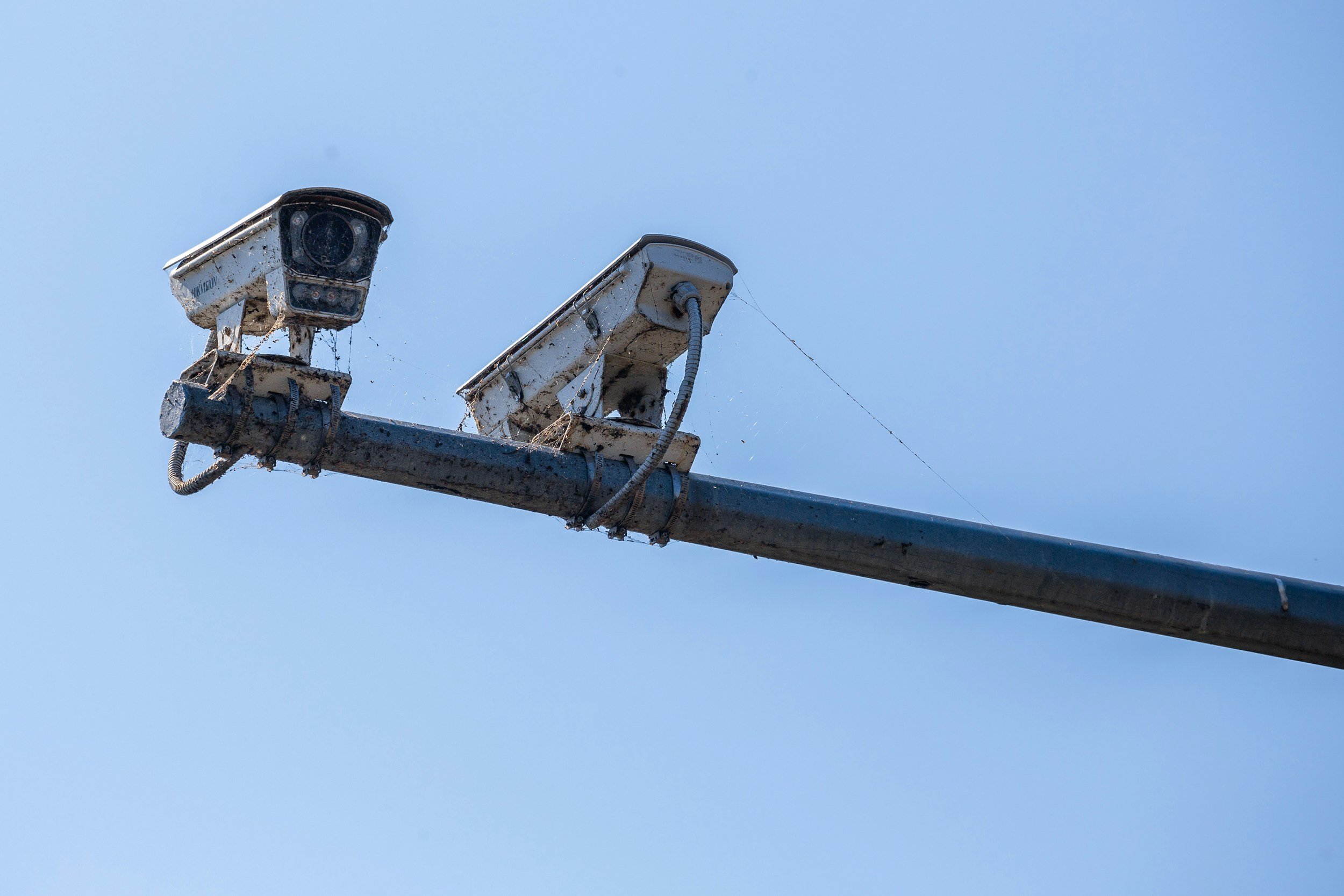
Notice the cameras?
You've probably seen them without really noticing: little camera boxes mounted on poles, bridges, and patrol cars.
If you've ever told a survivor "just be careful where you post" or "leave your phone at home if you're worried," you were giving good advice a few years ago. That advice is starting to fall apart.
Here's why.
The Cameras We Already Knew About
You've probably seen them without really noticing: little camera boxes mounted on poles, bridges, and patrol cars. They snap a photo of every license plate that drives by and log the time and place. Police departments use systems like Flock Safety to find stolen cars, locate missing people, and help solve crimes.
That's the pitch, anyway. In reality, the same database that can find a missing teenager can also help an officer find his ex.
A review by the Institute for Justice has turned up at least 18 cases around the country where police officers used these plate reader systems to track someone they were romantically interested in, with most of these cases happening since 2024. That's not a fluke or a one off problem. That's a pattern, and if you've worked with survivors for any length of time, the pattern will sound painfully familiar. Institute for Justice
A few examples make it real:
In Florida, an officer pulled up his ex-girlfriend's plate, and her family's plates, over 100 times in seven months. His coworkers noticed and told him to knock it off. He didn't, until he got caught. Investigators later learned this same officer had been pressuring his girlfriend to stay on FaceTime during his work shifts and had secretly slipped a tracking tag into her wallet. Tom's Hardware
In Tennessee, a deputy was pulled off duty after he reportedly searched his ex-wife's plate over 100 times.
In Milwaukee, an officer got charged after allegedly running plate searches 179 times in two months to keep tabs on a woman he was dating and her ex, writing down "investigation" as his reason every single time even though there was no actual case open. Inkl
In Kansas, a police chief quit after allegedly tracking his ex-girlfriend and her new boyfriend more than 200 times. A lieutenant in a different Kansas department pleaded guilty to stalking after doing the same thing to his estranged wife.
And here's the part that should really bother you: most of these cases weren't caught by the police departments themselves.
The Milwaukee case only came out because one of the women being tracked happened to look up her own plate number on a public website that publishes plate reader search logs. She found her own stalking case by accident. Inkl
So the people getting stalked are often the ones doing the detective work, not the departments that are supposed to be watching for abuse.

Once it learns that your phone, your watch, and your car always travel together, it can recognize "you" even if you swap cars or take the plate off.
The New Thing Nobody's Talking About Yet
If that's the danger we already knew about, brace yourself, because something new just landed, and it's a much bigger problem.
This month(June 2026), the outlet 404 Media got hold of marketing materials for a system called ELSAG SignalTrace, made by Leonardo US, the American branch of an Italian defense company. It's been around quietly for a couple of years, patented back in 2024, and it's now being actively sold to police departments across the U.S. The Pugilist
Here's the difference. SignalTrace plugs into the same plate cameras that are already up. But instead of just snapping your plate, it scans every signal your devices give off as you drive past: your phone's Bluetooth, your laptop's Wi-Fi, your smartwatch, even your dog's or cat's microchip. All of that gets time stamped, tied to your plate, and saved for later.
The company's own pitch to police is basically this: stop relying only on the plate, and start tracking the whole bundle of devices that travels with a person.
Which means all that classic safety advice, leave your phone at home, turn off location services, get a Faraday bag, doesn't fully work anymore. The system isn't reading your phone's GPS. It's reading the radio signal your phone gives off just by existing. Once it learns that your phone, your watch, and your car always travel together, it can recognize "you" even if you swap cars or take the plate off.
There's no warrant involved. No notice when a department buys it. No way to know you drove past one. And the data isn't sitting in a police evidence room. It's sitting in a private company's database, available to search whenever someone wants to look.
Right now, almost nothing legally stops this. A couple of states are starting to catch up. New Mexico passed a law this year limiting how plate data gets shared, but it only covers plates, not the Bluetooth and Wi-Fi signals SignalTrace is built to grab. Washington State has a stronger law. Minnesota and Colorado have bills moving. Most states have nothing on the books at all.
Okay, Breathe. Here's What You Can Actually Do
That's a lot to take in, especially if you're someone who has already rebuilt your whole life around staying hidden from someone dangerous. Before anything else: you are not powerless here, and you have not failed at safety by not knowing about a technology that barely existed publicly until a few weeks ago. Nobody could have planned around that. This is a gap in the law, not a gap in your judgment.

Make awareness calls
A lot of advocates, prosecutors, and judges haven't heard of SignalTrace yet.
A few things that genuinely help, starting now:
Your documentation habit still works, and it matters more than ever. If you notice a pattern, someone knowing where you were without being told, showing up somewhere you didn't expect, write it down. Dates, places, what happened. This is exactly the kind of pattern the EAA was built to help survivors capture, and it's the same kind of record that eventually exposed every single officer named above. Their stalking didn't get caught by luck. It got caught because someone built a paper trail and pushed it forward, sometimes for months, before anyone listened.
You have a real, legal right to ask. You can request, in writing, that your local police department tell you whether anyone has searched for your plate or your devices, and why. Most departments are required to keep that log. That exact kind of log is what cracked open the Milwaukee and Kansas cases.
You're not the only line of defense, and you shouldn't have to be. This is bigger than any one person's vigilance, which is exactly why the next section matters. Real change here is coming from legislatures, city councils, and legal advocates, people doing the structural work so survivors don't have to outsmart a surveillance system alone.
If something about this feels overwhelming to carry alone, that's a normal response to a genuinely unsettling piece of news, not a sign that something is wrong with you. Talking it through with an advocate, a counselor, or someone in your safety network is a reasonable next step, not an overreaction.
Where to Actually Put Your Energy
One person being careful can only do so much against a system this big. The people working on this seriously will tell you the real leverage is in legislatures and city halls, not waiting on courts or hoping companies regulate themselves.
A few concrete things that actually move the needle:
Call or email your state legislator. Ask plainly whether your state's plate reader laws cover device tracking too, not just plates. Most states, even ones with decent plate laws, say nothing about Bluetooth or Wi-Fi tracking. That's the exact gap that let SignalTrace slide in unnoticed. A short, specific note asking them to close it goes further than you'd think.
Show up at city council or county commission meetings. Ask whether your local department has bought, or is considering buying, SignalTrace or anything like it. Some of the strongest protections out there started with a local government simply saying no before the technology got a foothold.
Support the groups doing the legal fight. The ACLU and the Electronic Frontier Foundation are both building legal challenges to warrantless plate and device tracking. That kind of work is slow and expensive, and it needs people behind it.
If you work with survivors, talk about this. A lot of advocates, prosecutors, and judges haven't heard of SignalTrace yet. The officers above mostly got caught because survivors and reporters did the digging that internal police review failed to do. Awareness is doing a lot of the protective work here, so spreading it matters.
Document the Abuse exists because survivors shouldn't have to carry the entire burden of staying safe on their own shoulders. Technology like this keeps shifting that burden right back onto the people with the least power to fight it. Naming it clearly, and pushing on the places that can actually change it, is how we shift it back where it belongs.
QUESTIONS YOU MAY HAVE
-
It's a surveillance add-on made by defense contractor Leonardo that clips onto existing police license plate cameras. Instead of just photographing your plate, it picks up signals from your phone, smartwatch, laptop, and even pet microchips, and links all of it to your plate in a database.
-
With SignalTrace, yes, currently. There's no federal law requiring a warrant for this kind of device signal collection, and most states haven't passed laws covering it yet.
-
Yes. The Institute for Justice has documented at least 18 cases of officers using plate reader systems to track current or former partners, several resulting in criminal charges.
-
You can request in writing that your local police department disclose whether your plate or devices have been searched, and why. Departments are increasingly required to log these searches.
-
Contact your state legislator about closing the device-tracking gap in plate privacy laws, ask your city council whether your department has purchased SignalTrace, and support organizations like the ACLU and EFF that are building legal challenges.
Other articles from our Learning Hub:
Behind every download of the Evidentiary Abuse Affidavit, every resource accessed, and every article read is a survivor looking for a way forward. Your donation, whether a one-time gift or a recurring monthly contribution, makes sure those resources stay free and within reach. No survivor should have to go without the tools that could protect their life.

If you are a victim of violence, stalking, or harassment this link takes you directly to the Evidentiary Abuse Affidavit. CLICK HERE